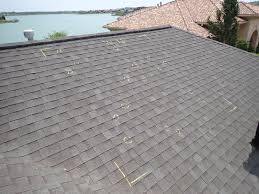
A homeowner walks their driveway after a hailstorm, looks up at the shingles, and sees bruising, granule loss, or a cracked tab. The damage is visible because asphalt shingles are a hard, granulated surface sitting a few feet from eye level. A commercial low-slope roof does not work that way. The membrane sits flat, forty or sixty feet up, out of sight from the parking lot, and the surface itself can take a hard hit without showing an obvious mark.
That gap between what a hailstorm actually does to a low-slope assembly and what a property manager can see from the ground is where a lot of Calgary buildings end up under-assessed after storm season. Alberta’s hail corridor runs straight through the city most summers, and by late August, the roofs that took a hit in June or July have had weeks to sit with damage nobody has documented yet. This article walks through what hail actually does to a commercial roof assembly and how a real assessment is supposed to work.
Why the Damage Hides Under the Surface
Shingles fail visibly because granule loss exposes the asphalt mat underneath, and that discoloration is easy to spot from below. A modified bitumen or single-ply membrane does not expose an underlying layer the same way. A hailstone striking a cap sheet can bruise the material, fracture the reinforcement scrim inside it, or drive a small puncture through a seam without leaving a mark that reads as damage to someone glancing up from the ground.
That is the core problem with hail on low-slope roofs. The membrane can be structurally compromised today and pass a casual glance for months, right up until a spring thaw sends meltwater through a fracture nobody knew was there. By the time water shows up on the ceiling tile below, the roof has already had a full winter of freeze-thaw cycling working that fracture wider.
Modified Bitumen: Bruising and Reinforcement Fracture
On a modified bitumen system, hail impact energy transfers through the cap sheet into the reinforcement mat, whether that is a polyester or fiberglass scrim. A hard enough impact can fracture the reinforcement fibers while the surface coating stays largely intact. This is what inspectors mean by bruising: a soft spot where the mat has lost tensile strength even though nothing is torn open yet.
A bruised membrane still sheds water on day one. It is the fatigue that follows that matters. Calgary’s Chinook cycles mean a bruised section goes through repeated expansion and contraction as temperatures swing, sometimes twenty or thirty degrees in a single day. Each cycle works at that weakened spot a little more. What starts as an invisible bruise in August can be a split by the following spring.
Single-Ply: Punctures and Displaced Ballast
TPO and EPDM behave differently under hail. These membranes are thinner and more flexible than modified bitumen, which means they are less prone to bruising but more prone to a clean puncture where a large stone hits at the right angle, particularly over an unsupported area between insulation joints or near a seam that has already seen some wear.
Ballasted single-ply systems introduce a second problem entirely separate from the membrane itself. Hail can dislodge or redistribute the stone ballast, and once ballast shifts, it stops doing its job of holding the membrane down and protecting it from UV and wind uplift. An inspector checking a ballasted roof after a storm has to look at ballast distribution as its own line item, not just scan for punctures.
The Test-Square Method
- A representative sample area, typically ten feet by ten feet, is marked out in a section of the roof exposed to the storm
- The inspector walks that square slowly, checking for punctures, granule displacement, and soft or spongy spots that indicate bruising underneath
- Suspect areas get a controlled hand-probe, not a boot press, to feel for reinforcement fracture without creating new damage
- Multiple test squares get run across different roof slopes and exposures, since hail impact is rarely uniform across a whole building
- Findings from each square get logged with location, count of confirmed impacts, and severity, not just a general impression
This is a defined method, not a walk-through. A single test square on a leeward slope can look almost clean while a windward section fifty feet away shows heavy impact density. Running the method properly is what separates a real hail assessment from someone standing at the roof hatch and deciding the roof looks fine.
Why a Walk-and-Look Is Not an Assessment
A general contractor or a maintenance tech can walk a roof, take a few photos, and call it inspected. That is not the same thing as a hail damage assessment, and the difference matters most when an insurance claim is on the table. HAAG certified inspectors are trained specifically to distinguish hail impact from mechanical damage, foot traffic wear, and ordinary aging, and to document findings in a format an adjuster can actually evaluate against.
The distinction is not academic. Insurers routinely push back on claims that rely on vague photo documentation without impact counts, test-square data, or a clear chain of evidence tying the damage to a specific storm date. A walk-and-look gets a property manager a gut feeling. A structured assessment gets them a claim that holds up.
Documenting for the Insurer
Insurance documentation for a commercial hail claim needs to answer a few specific questions: when did the storm occur, what is the impact density per test square, what is the condition of the membrane at each confirmed impact point, and how does that compare to the roof’s condition before the storm. Photos alone rarely answer all four.
A Calgary commercial roofing inspection and analysis that produces a written report with impact counts, photo documentation tied to specific roof zones, and a professional opinion on cause gives a property manager something an adjuster can act on quickly. Without that structure, claims tend to sit in review longer, and the roof sits exposed longer while the paperwork gets sorted out.
What the Report Should Actually Contain
A hail assessment report worth using for an insurance claim includes more than a photo folder. It should have a roof plan sketch marking where each test square was run, a tally of confirmed impacts per square, and a written opinion connecting the damage pattern to the storm date under review. Vague language like moderate damage observed, with no supporting counts, gives an adjuster nothing concrete to evaluate.
The report should also note conditions that are not storm related, distinguishing prior wear, foot traffic damage, or existing repairs from the fresh hail impacts. Separating these out matters, because a report that lumps everything together as storm damage tends to draw more scrutiny, not less, and can slow a claim down rather than speed it up.
Turnaround time matters too. A report that takes weeks to produce after the site visit delays the whole claims process, and photographs without dates or roof-zone labels lose most of their evidentiary value once time passes and memory of exact locations fades.
Why Timing Matters in a Hail Corridor
Calgary and the surrounding foothills sit inside one of the more active hail corridors in Canada, and storm cells that track through the city in June, July, and August can hit one commercial district hard while missing a neighborhood a few kilometers away entirely. That variability is exactly why a building specific assessment matters more than a general assumption about whether a given year was bad for hail overall.
Timing the assessment matters too. Waiting until spring to check a roof that took a hit in July means the membrane has already gone through a full freeze-thaw season on compromised material. An assessment run within a reasonable window of the storm catches damage while it is still assessable and while a claim still has a clean, well-documented storm date behind it.
The Cost of Assuming a Roof Is Fine
A low-slope commercial roof that took a hard hail hit and shows nothing obvious from the ground is not a roof that dodged the storm. It is a roof that needs someone to actually check. The gap between what is visible and what is structurally happening under the membrane is the entire reason test-square assessments exist as a discipline, and it is the reason a general walk-through does not substitute for one.
Property managers who wait for a leak to show up on the ceiling before calling for an inspection are usually looking at a roof that has been compromised for months, sometimes through an entire winter of freeze-thaw cycling. Getting a HAAG certified assessment done in the weeks after a storm, while the damage is fresh and the evidence is clean, is the difference between a documented claim and a guess.
About the author: this article was contributed by Superior Roofing Ltd., a Calgary commercial roofing contractor serving property managers and building owners across the city. The team includes HAAG certified inspectors trained in storm damage assessment, Red Seal journeymen handling repair work, and coverage of $10 million in liability on every commercial project.